

MQTT over UDP — Lightweight IoT Messaging Protocol
MQTT over UDP is a lightweight, low-latency messaging protocol designed to deliver MQTT-style publish/subscribe communication over UDP instead of TCP. It combines MQTT semantics (topics, payloads) with UDP speed (low overhead) and a custom reliability layer (ACK, retry, fragmentation), purpose-built for IoT devices, edge systems, industrial automation, and high-throughput real-time environments.
Low Latency
Removes TCP connection overhead, enabling ultra-fast message delivery for time-critical IoT telemetry and industrial automation.
Custom Reliability
Application-level ACK, retry, and fragmentation/reassembly ensure delivery guarantees without TCP's overhead on constrained networks.
Constrained Devices
Compact binary packets with minimal memory and CPU usage make it ideal for embedded systems, microcontrollers, and low-power IoT nodes.
Use Cases:
- IoT telemetry — sensors and medical devices
- Real-time monitoring systems
- Edge computing and industrial automation
- High-frequency, low-latency messaging
- Constrained devices with low memory/CPU
System Architecture
The protocol follows a clean client–transport–broker–subscriber model. Clients construct MQTT-style payloads, fragment them into UDP segments, and transmit with an application-level reliability layer. The server validates, buffers, and reassembles segments before dispatching to subscribers.
Client Components
- Payload Builder
- Fragmentation Engine
- Reliable UDP Sender
- ACK / Retry Handler (QoS 0/1/2)
- HMAC-SHA256 Authentication
Server (Broker) Components
- UDP Listener (Port 1774 default)
- Packet Validator + CRC Check
- Reassembly Engine
- Message Dispatcher
- Signature & Auth Verification
Subscriber Layer
- Sensor / Edge Applications
- Real-time Dashboards
- Cloud MQTT Bridge
- Alert & Notification Systems
- Data Logging Pipelines
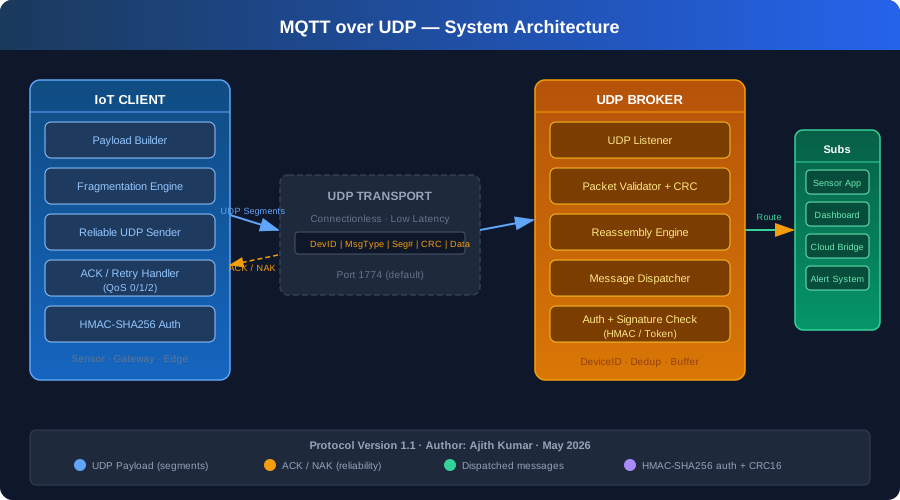
Fig 1 — MQTT over UDP System Architecture (Protocol v1.1, Author: Ajith Kumar, May 2026)
Packet Format Specification
Each UDP packet consists of a fixed 30-byte binary header followed by variable-length RawData carrying the MQTT topic and payload.
Header Fields:
RawData (Payload) Format:
Message Types:
| Code | Type | Direction |
|---|---|---|
| 0x0001 | MSG_PUBLISH | Client→Server |
| 0x0002 | MSG_SUBSCRIBE | Client→Server |
| 0x0003 | MSG_UNSUBSCRIBE | Client→Server |
| 0x0004 | MSG_PINGREQ | Client→Server |
| 0x0005 | MSG_CONNECT | Client→Server |
| 0x0006 | MSG_DISCONNECT | Client→Server |
| Code | Type | Meaning |
|---|---|---|
| 0x1001 | ACK_SUCCESS | Segment OK |
| 0x1002 | ACK_COMPLETE | Full msg received |
| 0x2001 | NAK_AUTH_FAIL | Auth failure |
| 0x2002 | NAK_INVALID_SEG | Bad segment # |
| 0x2003 | NAK_CHECKSUM | CRC mismatch |
| 0x2004/5 | NAK_MALFORMED/SIG | Invalid packet |
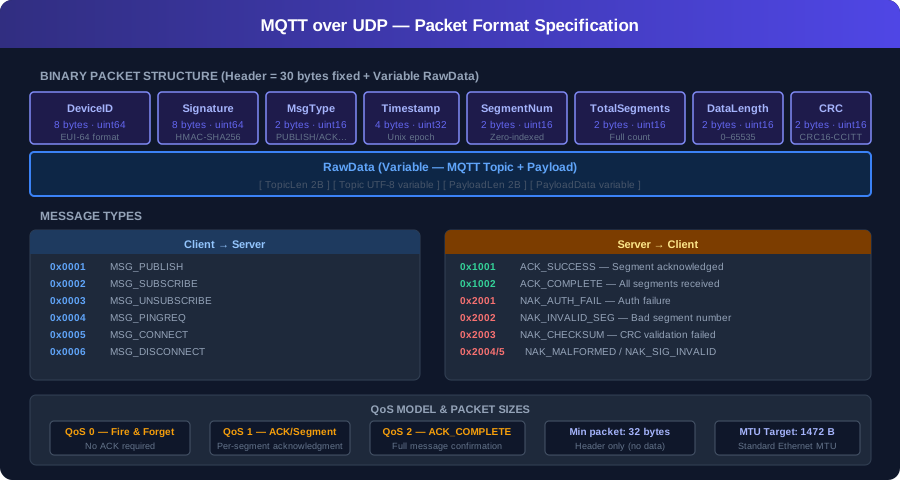
Fig 2 — Binary Packet Format with Header Fields, Message Types, and QoS Model
Reliability Model & Security
Reliability Mechanisms
- Timeout-based retransmission with retry limits
- Sliding window (4–7 segments recommended)
- Deduplication via DeviceID + Timestamp + SegmentNum
- Segment-index based reassembly
- CRC16-CCITT fast data integrity check
Security Architecture
- DTLS encryption (recommended for production)
- Optional AES payload encryption
- HMAC-SHA256 packet signature
- Token-based device authentication
- Timestamp-based replay attack mitigation
Protocol Comparison
XEUPD (eXtended Enhanced UDP Protocol) is our production-hardened implementation that addresses all UDP limitations while maintaining the speed advantage over TCP-based MQTT.
| Feature | MQTT / TCP | MQTT / UDP | XEUPD (Our Protocol) |
|---|---|---|---|
| Transport | TCP | UDP | UDP + Reliability Layer |
| Connection | Stateful (3-way HS) | Connectionless | Session-aware over UDP |
| Reliability | ✓ Built-in | ✗ None | ✓ Custom ACK + Retry |
| Latency | Moderate | Very Low | Ultra-Low |
| Protocol Overhead | High | Minimal | Low (optimized) |
| Fragmentation | TCP/IP Stack | App Responsibility | Intelligent Frag Engine |
| Packet Loss | Auto retransmit | Dropped | Selective retransmission |
| Scalability | Medium | Very High | Extremely High |
| Broadcast/Multicast | Limited | Supported | Native Optimized |
| IoT Suitability | Good | Very Good | Excellent |
| Security | TLS | DTLS / Custom | XEUPD Secure Layer |
| Real-Time Support | Limited | Strong | Enterprise-grade |
| Best Use Cases | Standard Messaging | Gaming, VoIP | IoT, Medical, Telemetry |
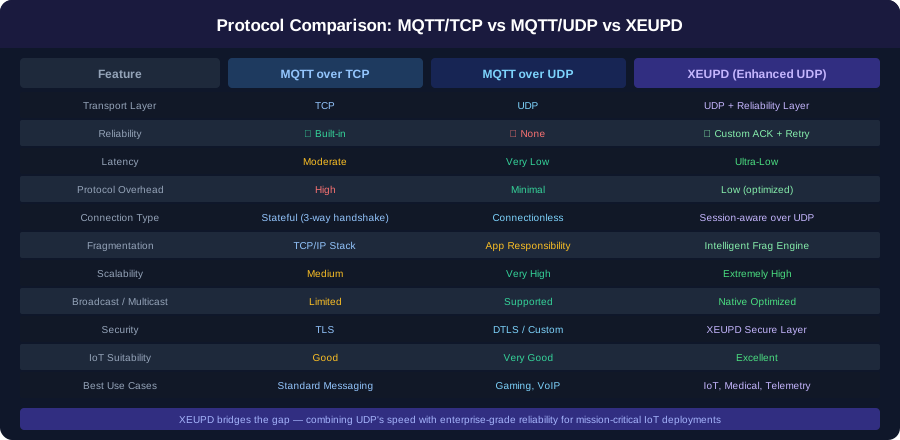
Fig 3 — Feature comparison of MQTT/TCP, MQTT/UDP, and XEUPD
Deployment & Future Roadmap
Production Setup
- Default UDP port: 1774
- Load-balanced UDP server clusters
- Optional MQTT bridge for legacy systems
- MTU-aware packet sizing (1472B Ethernet)
- High-performance Java library for easy integration
Future Enhancements
- Full MQTT QoS parity
- Adaptive congestion control
- Broker clustering support
- Cloud-native integration
- Advanced TLS offloading security